External ranking factors
Why inbound links to sites are taken into account
As you can see from the previous section, many factors influencing
the ranking process are under the control of webmasters. If these were
the only factors then it would be impossible for search engines to
distinguish between a genuine high-quality document and a page created
specifically to achieve high search ranking but containing no useful
information. For this reason, an analysis of inbound links to the page
being evaluated is one of the key factors in page ranking. This is the
only factor that is not controlled by the site owner.
It makes sense to assume that interesting sites will have more
inbound links. This is because owners of other sites on the Internet
will tend to have published links to a site if they think it is a
worthwhile resource. The search engine will use this inbound link
criterion in its evaluation of document significance.
Therefore, two main factors influence how pages are stored by the search engine and sorted for display in search results:
- Relevance, as described in the previous section on internal ranking factors.
- Number and quality of inbound links, also known as
link citation,
link popularity or
citation index. This will be described in the next section.
Link importance (citation index, link popularity)
You can easily see that simply counting the number of inbound links
does not give us enough information to evaluate a site. It is obvious
that a link from www.microsoft.com should mean much more than a link
from some homepage like www.hostingcompany.com/~myhomepage.html. You
have to take into account
link importance as well as number of links.
Search engines use the notion of citation index to evaluate the
number and quality of inbound links to a site. Citation index is a
numeric estimate of the popularity of a resource expressed as an
absolute value representing page importance. Each search engine uses its
own algorithms to estimate a page citation index. As a rule, these
values are not published.
As well as the absolute citation index value, a scaled citation index
is sometimes used. This relative value indicates the popularity of a
page relative to the popularity of other pages on the Internet. You will
find a detailed description of citation indexes and the algorithms used
for their estimation in the next sections.
Link text (anchor text)
The link text of any inbound site link is vitally important in search
result ranking. The anchor (or link) text is the text between the HTML
tags «A» and «/A» and is displayed as the text that you click in a
browser to go to a new page. If the link text contains appropriate
keywords, the search engine regards it as an additional and highly
significant recommendation that the site actually contains valuable
information relevant to the search query.
Relevance of referring pages
As well as link text, search engines also take into account the overall information content of each referring page.
Example: Suppose we are using seo to promote a car sales resource.
In this case a link from a site about car repairs will have much more
importance that a similar link from a site about gardening. The first
link is published on a resource having a similar topic so it will be
more important for search engines.
Google PageRank – theoretical basics
The Google company was the first company to patent the system of
taking into account inbound links. The algorithm was named PageRank. In
this section, we will describe this algorithm and how it can influence
search result ranking.
PageRank is estimated separately for each web page and is determined
by the PageRank (citation) of other pages referring to it. It is a kind
of “virtuous circle.” The main task is to find the criterion that
determines page importance. In the case of PageRank, it is the
possible frequency of visits to a page.
I shall now describe how user’s behavior when following links to surf
the network is modeled. It is assumed that the user starts viewing
sites from some random page. Then he or she follows links to other web
resources. There is always a possibility that the user may leave a site
without following any outbound link and start viewing documents from a
random page. The PageRank algorithm estimates the probability of this
event as 0.15 at each step. The probability that our user continues
surfing by following one of the links available on the current page is
therefore 0.85, assuming that all links are equal in this case. If he or
she continues surfing indefinitely, popular pages will be visited many
more times than the less popular pages.
The PageRank of a specified web page is thus defined as
the probability that a user may visit the web page.
It follows that, the sum of probabilities for all existing web pages is
exactly one because the user is assumed to be visiting at least one
Internet page at any given moment.
Since it is not always convenient to work with these probabilities
the PageRank can be mathematically transformed into a more easily
understood number for viewing. For instance, we are used to seeing a
PageRank number between zero and ten on the Google Toolbar.
According to the ranking model described above:
- Each page on the Net (even if there are no inbound links to it)
initially has a PageRank greater than zero, although it will be very
small. There is a tiny chance that a user may accidentally navigate to
it.
- Each page that has outbound links distributes part of its PageRank
to the referenced page. The PageRank contributed to these linked-to
pages is inversely proportional to the total number of links on the
linked-from page – the more links it has, the lower the PageRank
allocated to each linked-to page.
- PageRank A “damping factor” is applied to this process so that the
total distributed page rank is reduced by 15%. This is equivalent to the
probability, described above, that the user will not visit any of the
linked-to pages but will navigate to an unrelated website.
Let us now see how this PageRank process might influence the process
of ranking search results. We say “might” because the pure PageRank
algorithm just described has not been used in the Google algorithm for
quite a while now. We will discuss a more current and sophisticated
version shortly. There is nothing difficult about the PageRank influence
– after the search engine finds a number of relevant documents (using
internal text criteria), they can be sorted according to the PageRank
since it would be logical to suppose that a document having a larger
number of high-quality inbound links contains the most valuable
information.
Thus, the PageRank algorithm "pushes up" those documents that are most popular outside the search engine as well.
Google PageRank – practical use
Currently, PageRank is not used directly in the Google algorithm.
This is to be expected since pure PageRank characterizes only the number
and the quality of inbound links to a site, but it completely ignores
the text of links and the information content of referring pages. These
factors are important in page ranking and they are taken into account in
later versions of the algorithm. It is thought that the current Google
ranking algorithm ranks pages according to thematic PageRank. In other
words, it emphasizes the importance of links from pages with content
related by similar topics or themes. The exact details of this algorithm
are known only to Google developers.
You can determine the PageRank value for any web page with the help
of the Google ToolBar that shows a PageRank value within the range from 0
to 10. It should be noted that the Google ToolBar does not show the
exact PageRank probability value, but the PageRank range a particular
site is in. Each range (from 0 to 10) is defined according to a
logarithmic scale.
Here is an example: each page has a real PageRank value known only
to Google. To derive a displayed PageRank range for their ToolBar, they
use a logarithmic scale as shown in this table
Real PR ToolBar PR
1-10 1
10-100 2
100-1000 3
1000-10.000 4
Etc.
This shows that the PageRank ranges displayed on the Google ToolBar
are not all equal. It is easy, for example, to increase PageRank from
one to two, while it is much more difficult to increase it from six to
seven.
In practice, PageRank is mainly used for two purposes:
1. Quick check of the sites popularity. PageRank does not give exact
information about referring pages, but it allows you to quickly and
easily get a feel for the sites popularity level and to follow trends
that may result from your seo work. You can use the following “Rule of
thumb” measures for English language sites: PR 4-5 is typical for most
sites with average popularity. PR 6 indicates a very popular site while
PR 7 is almost unreachable for a regular webmaster. You should
congratulate yourself if you manage to achieve it. PR 8, 9, 10 can only
be achieved by the sites of large companies such as Microsoft, Google,
etc. PageRank is also useful when exchanging links and in similar
situations. You can compare the quality of the pages offered in the
exchange with pages from your own site to decide if the exchange should
be accepted.
2. Evaluation of the competitiveness level for a search query is a
vital part of seo work. Although PageRank is not used directly in the
ranking algorithms, it allows you to indirectly evaluate relative site
competitiveness for a particular query. For example, if the search
engine displays sites with PageRank 6-7 in the top search results, a
site with PageRank 4 is not likely to get to the top of the results list
using the same search query.
It is important to recognize that the PageRank values displayed on
the Google ToolBar are recalculated only occasionally (every few months)
so the Google ToolBar displays somewhat outdated information. This
means that the Google search engine tracks changes in inbound links much
faster than these changes are reflected on the Google ToolBar.
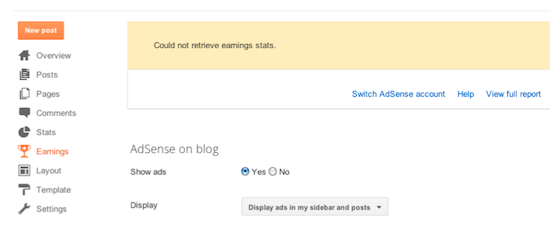 The error message above can occur when 3rd-party Access has been
disabled in your AdSense account. To re-enable access to your AdSense
account by Blogger, please log in to your AdSense account, and click the
Account Settings link. You'll see an enable access
link next to blogger.com, you must click this link in order to create
ads with Blogger tools. You will then be able to log back into
blogger.com and continue setting up AdSense from the Earnings tab.
The error message above can occur when 3rd-party Access has been
disabled in your AdSense account. To re-enable access to your AdSense
account by Blogger, please log in to your AdSense account, and click the
Account Settings link. You'll see an enable access
link next to blogger.com, you must click this link in order to create
ads with Blogger tools. You will then be able to log back into
blogger.com and continue setting up AdSense from the Earnings tab.


